
Choosing the right Chinese sleeping bag manufacturer requires more than comparing prices. Global buyers must examine materials, production controls, communication, and delivery reliability. This guide introduces China’s leading sleeping bag manufacturers for professional sourcing decisions.
Experienced suppliers usually offer down, synthetic, camping, military-style, and custom sleeping bags. However, product categories can differ between websites and actual factory capabilities. Buyers should request recent samples, fabric specifications, insulation data, and clear temperature ratings. A product labeled “Sleeping Bag Bag” may reflect awkward wording, not a recognized technical category. Careful verification matters.
Reliable manufacturers should explain their quality-control process in practical terms. Look for stitching inspections, zipper testing, filling-weight checks, odor control, and packaging reviews. Factory audits can reveal storage conditions, worker organization, and production capacity. Certifications may support credibility, but buyers should verify their scope and validity. A certificate alone proves little.
Supplier evaluation should also include minimum order quantities, sample fees, customization limits, lead times, and after-sales support. Ask how the factory handles uneven filling or damaged zippers. These small details often influence customer satisfaction. Price is important, but consistency matters more.
This overview focuses on manufacturers with export experience, transparent communication, and measurable production standards. It does not assume every large supplier is suitable for every buyer. Some factories may perform well with bulk orders but struggle with small custom projects. Others may offer attractive samples yet provide weaker mass-production control. A thoughtful comparison can reduce avoidable risks and support long-term business relationships.
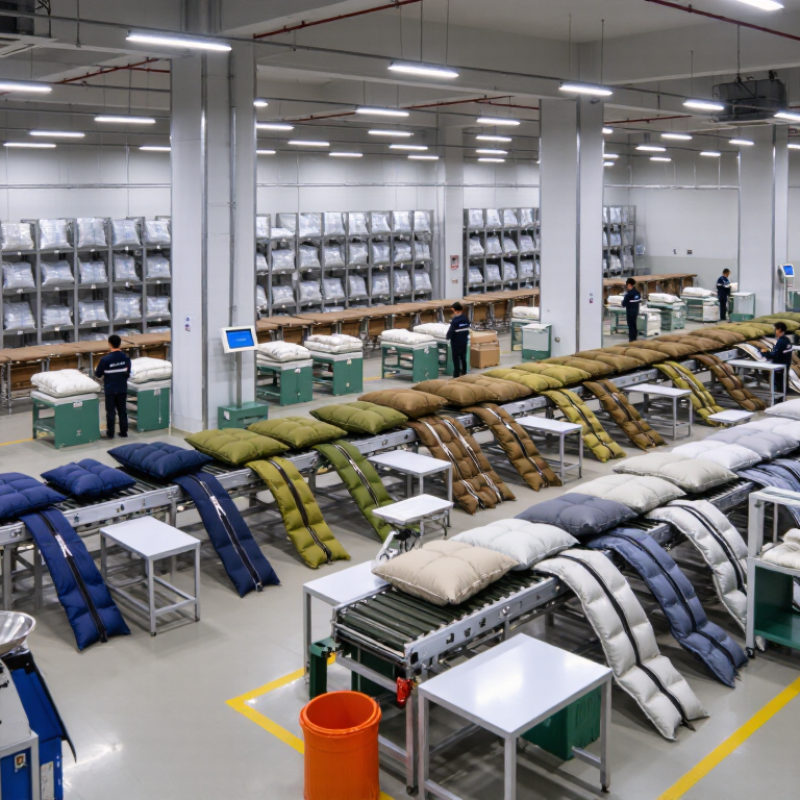
China’s sleeping bag supply base offers considerable OEM depth for global buyers. Factories can adjust shell fabrics, baffle layouts, hood shapes, zippers, sizing, labels, and packing methods. Many also support technical samples before bulk production. A practical factory review should examine sewing accuracy, down leakage, seam strength, and packing recovery. Photos alone are not enough.
Down fill power commonly ranges from 550 to 900 FP. A 550 FP sleeping bag may suit value-focused camping programs, while 700–800 FP balances warmth, weight, and cost. A 900 FP option can reduce packed volume, but it usually requires cleaner, carefully sorted down and tighter process control. The number needs verification. Ask for test reports, fill-weight records, and batch-level inspection details. Fill power does not replace correct temperature design.
OEM development can include custom warmth ratings, women’s and men’s fits, wider footboxes, and different draft-collar structures. Factories may also combine 700 FP down with recycled shell fabrics or water-resistant treatments. However, material claims should be checked against current documentation. I would not approve a large order from one attractive prototype. Bulk samples can reveal uneven filling, stiff zippers, or cold spots near the knees. This is where many plans become less perfect. A careful buyer should compare at least two production samples and record every revision.
When ranking sleeping bag manufacturers, begin with verified ISO 23537 test reports. This standard evaluates thermal performance under controlled laboratory conditions. Request reports for the exact model, filling weight, fabric, and construction. Check whether the testing laboratory is competent and independently recognized. A warm-looking sample proves little. Test details matter more. Do not compare temperature results without checking the same test method. I once overvalued a low price and ignored inconsistent zipper performance. That mistake could have been avoided.
MOQ should be judged against total purchasing risk, not only the quoted number. A low MOQ may hide higher unit costs, limited fabric choices, or weaker production priority. Ask for sample, pilot-order, and repeat-order quantities. Compare lead times during peak seasons. OEM capacity includes pattern development, material sourcing, sample revisions, and stable mass production. Review the manufacturer’s equipment, inspection records, and corrective-action process. Request production photos, but verify them during a video audit or site visit. Confirm traceability for insulation, shell fabric, and packaging. The strongest suppliers explain limitations clearly. That is a useful reliability signal. A ranking can still be imperfect when factory data is incomplete. Recheck claims before signing a long-term agreement.
China’s sleeping bag manufacturers support outdoor retailers, travel suppliers, and institutional buyers worldwide. Their product ranges include down, synthetic, military, and ultralight sleeping bags. Experienced factories usually offer sampling, material selection, and production adjustments before bulk orders. This process helps buyers match insulation, climate, packing size, and target cost.
Down Sleeping Bags Down sleeping bags provide strong warmth with low weight, especially in dry, cold conditions.
Synthetic Insulation Synthetic insulation remains practical for damp camps and frequent washing.
Military Sleeping Bags Military sleeping bags often emphasize durability, wide temperature coverage, and easy maintenance.
Ultralight Models Ultralight models use narrow profiles, lightweight shell fabrics, and carefully measured insulation.
Buyers should request fill-power data, fabric specifications, zipper details, and tested temperature ratings. ISO 23537 testing can provide a useful comparison, although field comfort varies between users.
Reliable suppliers explain their testing methods instead of making vague warmth claims. Factory visits, pre-production samples, and inspection records can reveal stitching gaps, uneven filling, or weak compression bags.
I have found that small details matter, such as a draft collar closing smoothly with gloves. Not every sample performs perfectly. Some designs feel restrictive, and advertised weight may exclude accessories.
Clear communication is essential. Ask for production tolerances, washing guidance, carton details, and corrective procedures before placing a large order.
Buyer due diligence should begin with a written quality plan, not a catalog. When I assess sleeping bag suppliers, I request an AQL 2.5 inspection plan with defined critical, major, and minor defects. AQL 2.5 does not mean 2.5% of every shipment is automatically acceptable. The sample size, inspection level, and acceptance numbers must be agreed before production. Inspectors should check insulation weight, zipper function, stitching, dimensions, fabric damage, and packaging. Photos with measurements are useful evidence.
Lead times need practical discussion. Ask for separate estimates for fabric sourcing, sample approval, bulk production, inspection, and shipping preparation. A supplier may quote 25 days, but that figure can exclude material delays. Build a buffer. It matters.
I also request at least one development sample and one pre-production sample. Compare both against the approved specification, including loft, filling distribution, temperature claims, and label details. A rushed sample review often creates expensive corrections later.
Lab reports should identify the exact material and tested product. Check the laboratory’s accreditation, test date, methods, and report number. Confirm that results match the destination market’s requirements. Reports copied from another product are not reliable evidence. Request traceable fabric and filling documentation where possible. I have seen complete-looking files with missing test conditions, so skepticism is useful. Digital records help, but an on-site or independent inspection can reveal workmanship issues that paperwork misses. Some judgment remains imperfect. That is why every approval should record assumptions, tolerances, and unresolved risks.
For global buyers, sleeping bag compliance begins with measurable performance, not attractive product photos. ISO 23537-1 and ISO 23537-2 define thermal testing, dimensions, and user information requirements. A capable manufacturer should provide test reports showing laboratory conditions, declared temperature ratings, and sample traceability. Temperature claims can mislead when testing differs. Ask for the exact test method.
Responsible filling requires deeper evidence. The Responsible Down Standard verifies animal-welfare practices and supply-chain control, while the Global Recycled Standard checks recycled inputs, processing, and chain of custody. Textile Exchange reported global fiber production reached 124 million tonnes in 2023, increasing pressure for credible recycled-material records. Request transaction certificates, scope certificates, and batch-level documentation. Certificates alone are not a magic shield.
REACH screening should cover fabrics, coatings, dyes, zippers, and packaging, especially substances listed by the European Chemicals Agency. Manufacturers should retain supplier declarations and laboratory results for restricted chemicals. Under Incoterms 2020, define responsibility clearly: “FOB Shanghai” differs greatly from “DAP Rotterdam” for freight, insurance, customs, and import risk. The International Chamber of Commerce states that Incoterms allocate these obligations, but they do not replace a sales contract. One weakness remains: paperwork can hide inconsistent production. Buyers should audit factories, approve a sealed reference sample, and inspect finished cartons before shipment. Small checks prevent expensive surprises.
| Compliance or Buyer Dimension | Applicable Scope | What a Qualified Supplier Should Provide | Buyer Verification Points | Practical Purchasing Value |
|---|---|---|---|---|
|
ISO 23537 Sleeping bag performance |
Thermal performance, dimensions, mass, and related testing requirements for sleeping bags. | A current test report from a competent laboratory, with the tested product code, construction, filling, fabric, size, and test conditions clearly identified. | Confirm that the report matches the proposed production model. Review the declared comfort, limit, and extreme temperature ratings where applicable, and check whether the test method and product configuration are consistent. | Supports comparable performance claims and reduces the risk of inaccurate temperature-rating claims in technical files, catalogues, and online listings. |
|
RDS Responsible Down Standard |
Down and feathers used as filling materials, including responsible sourcing and chain-of-custody controls. | A valid RDS certificate covering the relevant facility and scope, together with transaction or supply-chain documentation for the down or feather content. | Check certificate validity, certified site address, product scope, certification body, and whether the material percentage and transaction records correspond to the purchase order. | Helps substantiate animal-welfare and responsible-sourcing claims for down-filled sleeping bags. Certification should not be assumed solely from a supplier's marketing statement. |
|
GRS Global Recycled Standard |
Recycled content and chain of custody for eligible materials such as recycled polyester shell fabric or lining. | A valid GRS certificate and supporting transaction documentation identifying the certified material, processing stages, and applicable product scope. | Verify the certified facility, material composition, recycled-content percentage, scope certificate, transaction certificate, and any restrictions on labeling or claims. | Provides traceability for recycled-content claims and supports sustainability documentation requested by retailers, brands, and institutional buyers. |
|
REACH EU chemical compliance |
Chemical substances in fabrics, coatings, trims, zippers, cords, prints, dyes, packaging components, and other articles supplied to the EU market. | A material declaration, restricted-substance test reports where relevant, supplier declarations, and technical information supporting compliance with Regulation (EC) No 1907/2006. | Review testing against the buyer's restricted-substance list and applicable REACH requirements. Pay particular attention to azo dyes, formaldehyde, phthalates, heavy metals, PFAS-related requirements, and SVHC communication duties where applicable. | Reduces customs, marketplace, recall, and regulatory risks for products entering the European Union. REACH compliance is a legal obligation, not automatically a standalone product certificate. |
|
Incoterms 2020 Delivery and risk allocation |
Allocation of transport obligations, costs, documentation, delivery point, and transfer of risk between seller and buyer. | A quotation and sales contract stating the named Incoterms 2020 rule, named place or port, currency, included charges, insurance responsibility, and export documentation responsibilities. | Confirm the exact named location. Distinguish between EXW, FCA, FOB, CIF, DAP, and DDP obligations, and verify who handles export clearance, import clearance, duties, taxes, inland delivery, and insurance. | Prevents hidden logistics costs and disputes caused by using an Incoterms rule without a precise named place or by treating delivery terms as a substitute for a full sales contract. |
|
Material Traceability Batch control |
Shell fabric, lining, insulation, down or synthetic fill, webbing, thread, trims, labels, and packaging. | Approved-material list, supplier records, batch or lot numbers, incoming inspection records, and production traceability from raw material to finished goods. | Select several finished units and trace them back to fabric, filling, accessories, and production records. Confirm that substitutions require written buyer approval. | Supports consistent quality, targeted corrective action, and faster investigation if a product or material issue occurs. |
|
Quality Control Production inspection |
Dimensions, fill weight, loft, stitching, zipper operation, seam strength, color consistency, odor, labeling, carton packing, and workmanship. | Approved sample, inspection specification, in-line inspection records, final inspection report, and documented corrective-action process. | Define acceptable quality limits before production. Check the first production sample, critical dimensions, filling distribution, compressed-pack size, zipper performance, and carton quantity. | Converts product expectations into measurable acceptance criteria and reduces variation between samples and mass production. |
|
Technical File Documentation readiness |
Product specifications, bill of materials, drawings, care instructions, test reports, declarations, labels, packaging artwork, and shipment records. | A controlled technical file with revision numbers, approved artwork, material composition, product measurements, test evidence, and document ownership. | Check that all documents refer to the same model, revision, and material configuration. Require advance notification of changes to fabric, filling, coating, factory, or subcontractor. | Improves audit readiness and helps align manufacturing, compliance, customs, logistics, and after-sales teams. |
|
Packaging & Labeling Market-entry information |
Product labels, fiber or filling disclosures, care instructions, country-of-origin information, carton marks, barcodes, and destination-market requirements. | Buyer-approved label artwork, packaging specification, carton packing list, barcode data, and destination-market labeling checklist. | Confirm language, mandatory declarations, temperature-rating presentation, material percentages, care symbols, carton markings, and consistency between physical labels and commercial documents. | Reduces relabeling, shipment delays, retail rejection, and consumer-information issues in different markets. |
|
Commercial Controls Order execution |
Product specification, quantity, price, lead time, payment milestones, inspection rights, warranty, claim handling, and change control. | A detailed purchase contract or purchase order with model codes, approved samples, tolerance limits, delivery term, named place, inspection standard, and remedy provisions. | Ensure the contract links compliance documents to the exact finished product. Define procedures for non-conforming goods, delayed shipment, unauthorized substitutions, and document discrepancies. | Creates a clear basis for supplier comparison and gives the buyer measurable remedies when production or documentation fails to meet the agreed specification. |
Buyer note: Certification and test evidence should always be checked against the exact manufacturing site, product model, material composition, certification scope, validity period, and destination-market requirements. Requirements may vary according to product configuration and country of sale.